There are few societal issues with more far-reaching consequences than how we should deal with AI.
That said, it’s interesting to see that some politicians seem to have switched their pending “apocalypse” fear campaign from climate to AI doom. It brings to mind this famous advice: “If you can keep your head when all about you are losing theirs and blaming it on you…”
Let’s see if we (a group of Critical Thinkers?) can come up with a meaningful answer to two pivotal questions:
a) Which should be our greater concern: AI development or AI deployment? (Spoiler Alert: my opinion is deployment, and I’ll discuss why in my next commentary.)
b) Since almost all of the public discussions are about regulating AI developers, does it make any sense to try to regulate AI development?
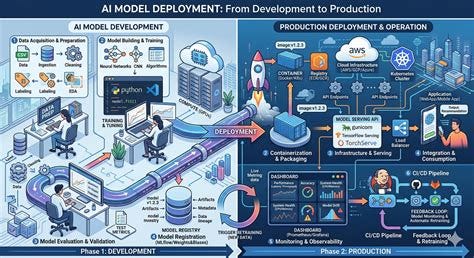
{Though this graphic is a bit fuzzy, it does show AI development vs deployment.}
Here are some representative questions related to regulating AI development. If I’ve missed any important ones, please let me know…
Question 1 —
Since the term “self-regulation” is not a binary choice, is allowing AI developers to self-regulate a real thing?
Question 2 —
Is AI development actually regulatable?
Question 3 —
Is AI development practically regulatable?
Question 4 —
If the answers to Questions 2 & 3 are YES, then what exactly would those regulations be? {See this commentary about AI “guardrails.”}
Question 5 —
Considering the technical complexity involved with the AI development issues, wouldn’t the AI development companies end up actually writing the regulations?
Question 6 —
Who (e.g., what federal agency) would be responsible for ensuring that all US companies complied with AI development regulations?
Question 7 —
How would {the designated federal agency} monitor that all US companies complied with AI development regulations?
Question 8 —
What penalties would there be for US companies that violated AI development regulations?
Question 9 —
Considering what is at stake, would said penalties for US companies that violated AI development regulations be a real deterrent?
Question 10 —
Would reasonably regulated US AI development companies having to compete with unregulated (or less regulated) international AI development companies be fair to them or to the U.S.?
Question 11 —
Assuming that US AI companies were reasonably regulated and were all in compliance, how would we deal with anti-American countries who would definitely want to use the AI tool like this to bring us down?
Question 12 —
Can regulation even be enforced against an AI model whose behavior is emergent and non-deterministic?
Question 13 —
What does AI development "compliance" mean for a probabilistic system? A company can pass every pre-deployment test and still ship an AI model that misbehaves later. What regulations would prevent that?
Question 14 —
Now that we see some of the foreseeable AI development regulation problems, should we stop focusing on regulating AI development and instead put most of our efforts into regulating AI deployment?
The Bottom Line:
My opinion is that regulating AI development is a waste of time. Specifically, such regulation will not produce any net positive results. Instead it will likely severely handicap American performance in a critically important market.
However, before making up your mind about the AI regulation question, please read Part 2 of my commentary.
Thanks for reading Critically Thinking About Select Societal Issues! Please pass a link to this article on to other associates who might benefit. They can subscribe for FREE to receive new posts (typically about twice a week.
Here is other information from this scientist that you might find interesting:
I urge all readers to subscribe to AlterAI — IMO the absolute best AI option for subjective questions.
I will consider posting reader submissions on Critical Thinking about my topics of interest.
My commentaries are my opinion about the material discussed therein, based on the information I have. If any readers have different information, please share it. If it is credible, I will be glad to reconsider my position.
Check out the Archives of this Critical Thinking substack.
C19Science.info is my one-page website that covers the lack of genuine Science behind our COVID-19 policies.
Election-Integrity.info is my one-page website that lists multiple major reports on the election integrity issue.
WiseEnergy.org is my multi-page website that discusses the Science (or lack thereof) behind our energy options.
Media Balance Newsletter: a free, twice-a-month newsletter that covers what the mainstream media does not do, on issues from climate to COVID, elections to education, renewables to religion, etc. Here are the Newsletter’s 2026 Archives. Please send me an email to get your free copy. When emailing me, please make sure to include your full name and the state where you live. (Of course, you can cancel the Media Balance Newsletter at any time!)
Globally there's no way to regulate AI, so the focus must be on how it's deployed and how to protect critical systems from being infiltrated. If all humans were basically good, there'd be no problem. But...some will undoubtedly develop and use AI as a weapon.
The genie is out of the bottle, and as far as I know there have never been magic words that put any genie back into any bottle.
How would US regulation of development or deployment affect Chinese or Russian or Iranian development or deployment?
It seems the big four American AI companies want anti-trust exemption so they can collude and fix prices while squeezing out smaller competitors. How is that a good thing?
If they were serious about their imagined problems, why don't they, as the experts, address the alleged problems, instead of asking some ignorant government bureaucrats to "handle it?"